
Moving to Myrtle Beach From NY, NJ or PA? 6 Mistakes to Avoid

If you're thinking about leaving New York, New Jersey or Pennsylvania for Myrtle Beach, here's something I've learned after 16 years of helping buyers make this move: the decision to move usually isn't the mistake. It's how you do it.
In this article I'll walk you through the six mistakes I see Northeast buyers make over and over again when they relocate to the Grand Strand, and exactly what to do instead.
Quick Summary
Decide whether you'll sell up north first or buy in Myrtle Beach first before you start looking.
Don't trust listing photos alone. See the home in person or get a live video walkthrough.
Budget for the move, not just the house, including South Carolina's yearly vehicle property tax.
Narrow your list to about five homes before you fly down, instead of trying to see 20 in a weekend.
South Carolina is a closing attorney state, and the contract process may work differently than you're used to.
Choose where to live based on your everyday routine, not where you stayed on vacation.
Mistake #1: Selling and Buying in the Wrong Order
This is the first question almost every relocating buyer asks me: "Mike, should I sell my house up there first, or buy down here first?"
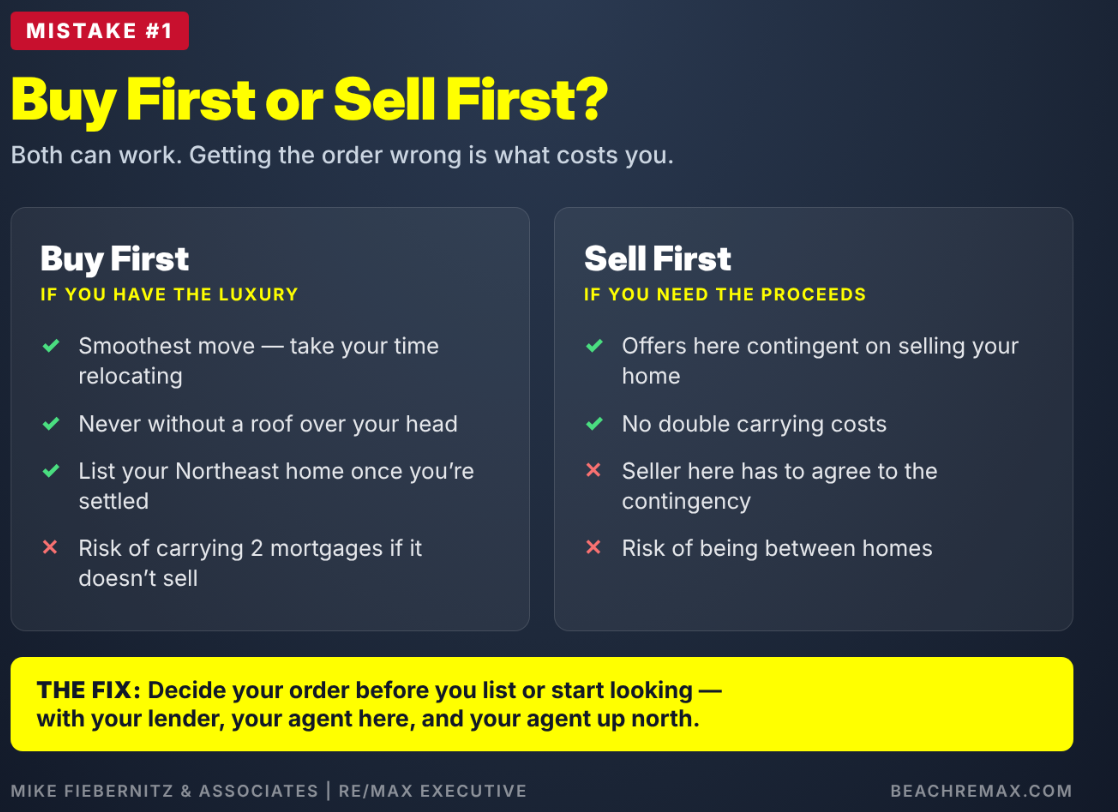
Here's the thing. If you get it wrong, it can cost you either way. Sell first, and you might end up without a roof over your head. Buy first without a plan, and you could be carrying two mortgages and two sets of carrying costs for an extended period of time.
The good news is there are options either way.
If You Can Buy First
If you have the luxury of buying down here first, it makes the whole transaction a lot smoother. You can take your time moving down, you're never without a place to live, and you can work with your agent up north on getting your house on the market and sold.
If You Need to Sell First
If you don't have that luxury, that's not a problem. My recommendation is to figure out how long your house will realistically take to sell up north, then make offers down here that are contingent on selling your home. You'll need a seller here to agree to that contingency, and a lot of sellers will agree to it for a short period of time.
The Fix: Decide Your Order Before You Start
Decide your order before you list your house or start looking at properties here. If you're financing, talk to a lender down here, talk to an agent here who has been through this process many times, and talk to your agent up north. That way everyone is working from the same time frames and the same negotiation strategy.
Mistake #2: Trusting the Listing Photos
Listing photos are there to sell the house and get a showing. That means wide-angle lenses, perfect lighting, and carefully cropped frames that leave out any eyesores.
What they won't show you is the busy road the house sits on, the drainage pond going in next door, or what's being built around you.
I've walked into plenty of homes where my buyers said, "If this checks out, this is the house." Then we got there and the photos hadn't shown repairs or damage inside, or we walked out to the backyard and there were massive metal power lines running right behind it.
The Fix: See It Yourself or Get a Live Walkthrough
Go look at the property in person whenever you can. If you can't make it down and it's a home that could move quickly, I'll do a live video walkthrough for you. I show you what's not in the listing pictures and point out any areas of concern.
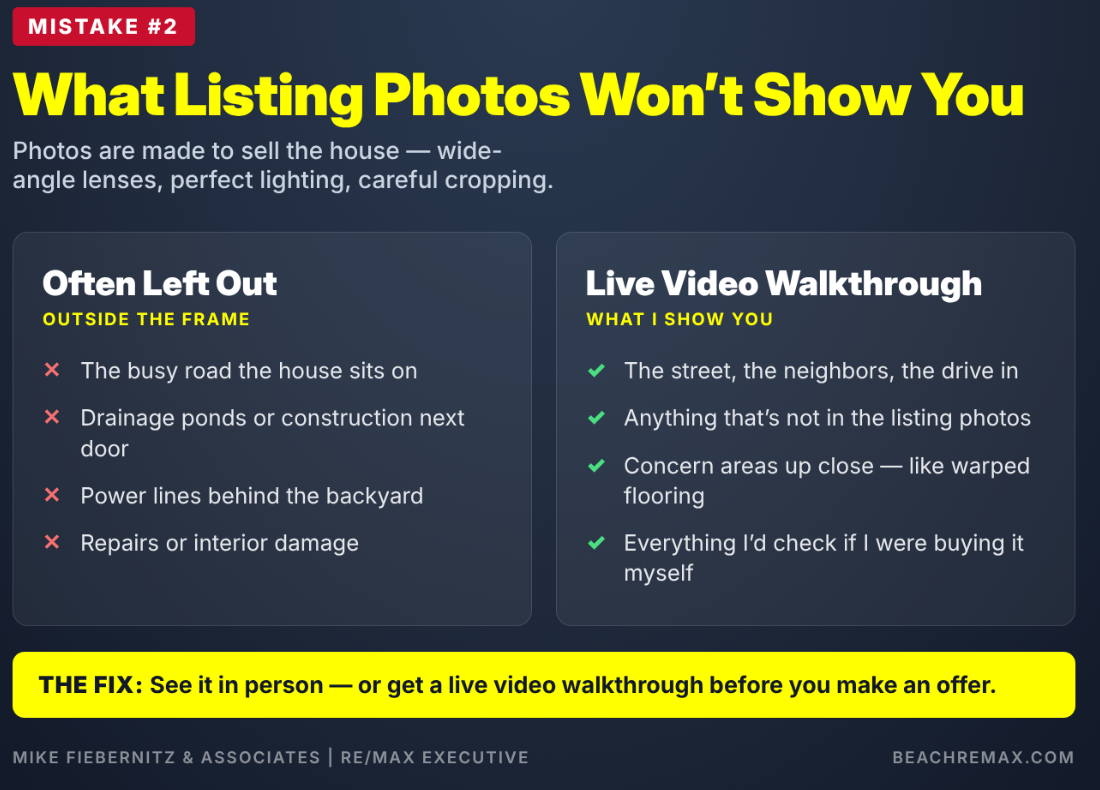
Just a couple of months ago, I did this for clients and showed them multiple angles of flooring that was warped from water damage to the subfloor. I wanted them to understand exactly what they'd be walking into, so there were no surprises. My rule of thumb is simple: I show you the concern areas as if I were buying the property myself.
Mistake #3: Budgeting for the House but Not the Move
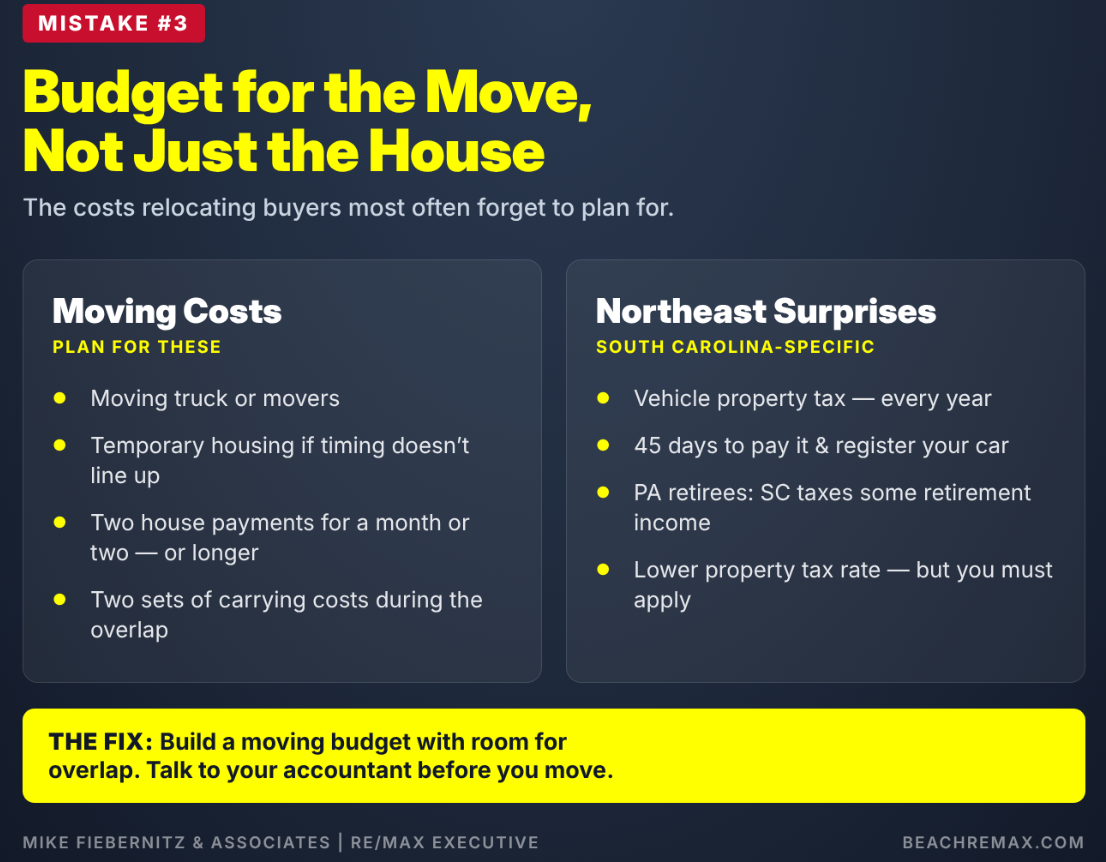
A lot of buyers budget carefully for the house itself, then forget to factor in what the actual move to South Carolina costs.
Moving Costs People Forget
Moving truck or movers
Temporary housing if your new home isn't ready or you're still waiting to close
Possibly two house payments and two sets of carrying costs for a month or two, or longer
Costs Northeast Buyers Don't Expect
In South Carolina, you pay property tax on your vehicles every single year. When you move here, you have 45 days to pay that tax and register your car.
If you're retiring from Pennsylvania, know this: Pennsylvania doesn't tax most retirement income, but South Carolina taxes some of it. Talk to your accountant before you move so you understand the difference instead of assuming you'll save.
The good news is that property taxes on your primary residence here are typically much lower than what you're paying up north. But that lower rate isn't automatic. You have to apply for it. I made a separate video that walks through exactly how to do that.
The Fix: Build a Moving Budget
Build a moving budget, not just a house budget, and plan for some overlap in case your timing doesn't line up perfectly.
Mistake #4: Trying to See Everything in One Weekend
Here's what usually happens. A couple contacts me, they want to move down here, and they plan to fly in to look at homes. Then they line up 15 to 20 houses in a three-day trip.
By the end of the trip, they can't remember which kitchen went with which house or which home they liked better. They fly home exhausted and no closer to making a decision.
The Fix: Narrow It Down Before You Fly
Work with your agent ahead of time to narrow the list to homes in the areas you actually want to live in, with the features you actually want. I've shown plenty of homes I knew my buyers wouldn't make an offer on, because the area didn't fit or the distance to the beach wasn't what they wanted.
When we eliminate those up front, we usually get the list down to about five. That way you're ready to make an offer on a home you love, instead of getting confused by 20 or 25 houses.
Mistake #5: Assuming the Process Works the Same as Up North
If you've bought a house before, you probably have a clear picture of how things should go. But every state does it a little differently, and South Carolina is no exception.
South Carolina Is a Closing Attorney State
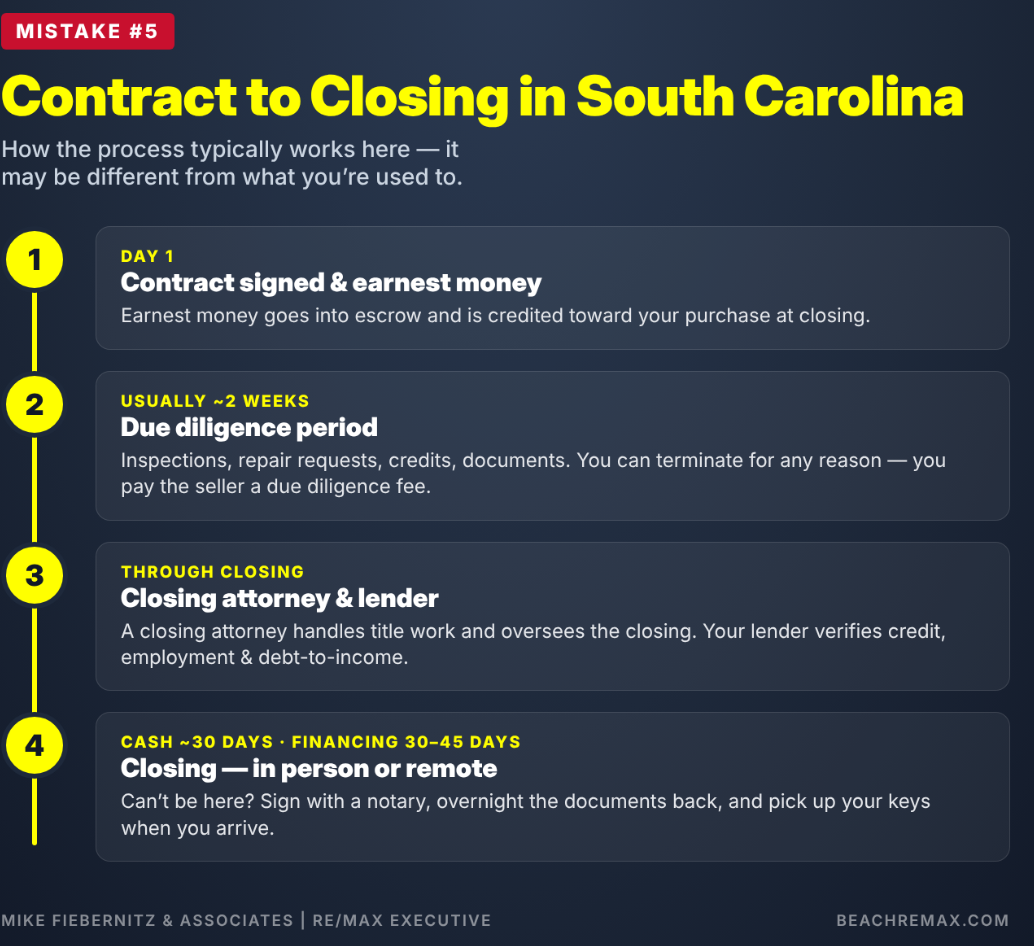
Here, a closing attorney handles the title work and oversees the closing. And if you can't be here in person, that's not a problem. Closings can often be handled remotely: the closing attorney sends you the documents, you sign them in front of a notary, and you send them back overnight. I can pick up the keys and do the final walkthrough for you, so when you get to town, you can drive right into the garage of your new home.
The Due Diligence Period
In South Carolina, you have what's called a due diligence period. It starts once you and the seller agree on the price and terms and ends on a date you negotiate together. In my experience, it's usually no more than about two weeks.
During that time you can get home inspections, make repair requests, ask for credits, and request documentation from the seller. You also have the right to terminate for any reason. To have that right, you pay the seller a due diligence fee, which I typically see in the $200 to $500 range.
Earnest Money
Earnest money is usually turned in right after you and the seller agree on the price and terms. It's held in escrow and credited toward your purchase when you close. It doesn't go to me, the other agent, or the sellers.
How Long It Takes to Close
For a cash purchase, plan for about 30 days. With financing, it's usually 30 to 45 days, depending mostly on your lender, who has to verify things like your credit, employment, and debt-to-income ratio.
The Fix: Ask Before You Write an Offer
Don't assume it works here exactly like it does up north. Before you write an offer, ask your agent about the timeline, negotiation strategy, any contingencies you need, and the deadlines in the contract, so you know when things end and can plan accordingly.
Mistake #6: Choosing Where to Live Based on Your Vacations
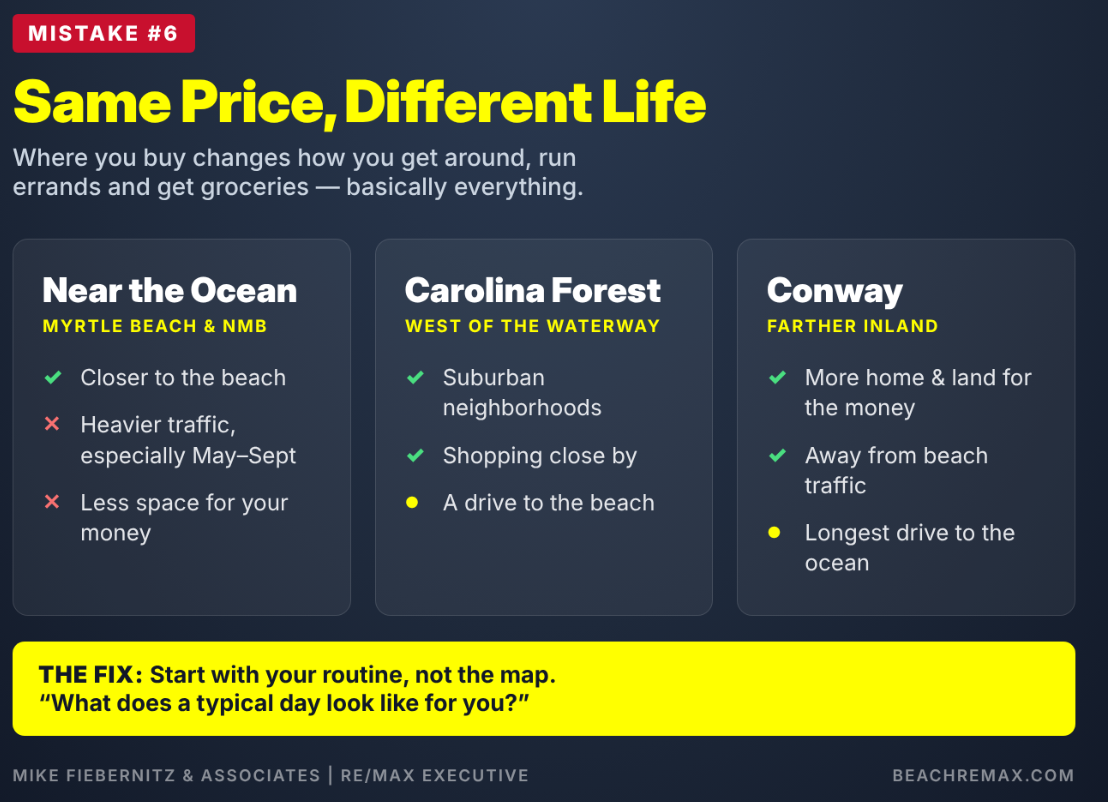
This is the biggest one. A lot of people pick where to live based on where they stayed on vacation, but living here and vacationing here are two completely different things. Where you buy changes how you get around, how you run errands, how you get groceries, basically everything.
Same Price, Different Life
Take two homes at the same price, and you can get two completely different living situations.
Carolina Forest, west of the Intracoastal Waterway, has a suburban feel: neighborhoods, subdivisions, and plenty of shopping close by that's easy to drive to.
If you're in Myrtle Beach proper or North Myrtle Beach close to the ocean, you're dealing with a lot more traffic. That frustrates a lot of buyers when all they want is to run to the grocery store for bread or milk.
Generally, the farther you go from the ocean, the more you get for your money. A home of about 2,500 square feet two blocks off the beach, east of Highway 17, can run close to $700,000. Out in Conway, you could probably get a 4,000-square-foot home on an acre of land for about the same price.
The Fix: Start With Your Routine, Not the Map
The question I always ask buyers is: what does a typical day look like for you? Do you golf two or three times a week? Do you want to deal with summer traffic? How often do you go to the doctor, and where is your doctor? Where is family located, if you have family here? How close do you want to be to the airport?
Once I know that, I can point you to the areas that fit the way you actually live.
A Real Example
I worked with a buyer who wanted to be a couple of blocks off the beach. When they came down during the summer, it was very difficult to get around because of the vacationers and traffic. After the third house, they asked me, "Mike, is the traffic this bad every summer, or is there an event going on?"
I told them that's how it usually is from early May to early September, and if that's not something they wanted to deal with every day, living that close to the beach might not be the right fit. They ended up deciding to buy outside the beach area, and I completely agreed with them.
Frequently Asked Questions
Should I sell my house up north before buying in Myrtle Beach?
It depends on your finances. If you can buy first, the move is usually much smoother. If you need to sell first, you can make offers contingent on selling your home, as long as the seller here agrees. Either way, decide your order before you start looking.
Can I buy a house in Myrtle Beach without being there in person?
Yes. Your agent can do a live video walkthrough, and closings can often be handled remotely by signing documents in front of a notary and sending them back overnight.
Do you pay tax on your car every year in South Carolina?
Yes. South Carolina charges property tax on vehicles every year. New residents have 45 days to pay that tax and register their car.
Do I need an attorney to buy a house in South Carolina?
Yes. South Carolina is a closing attorney state. A closing attorney handles the title work and oversees the closing.
How long does it take to close on a house in Myrtle Beach?
Typically about 30 days for a cash purchase and 30 to 45 days with financing, depending mostly on your lender.
Moving From Up North the Smart Way
Relocating from the Northeast to Myrtle Beach is a big decision, and most of these mistakes come down to planning. Decide your sell-or-buy order early, don't rely on photos alone, budget for the whole move, narrow your search before your trip, learn how the South Carolina process works, and choose your area based on everyday life, not vacation memories.
Related Articles
LINK: Moving to Myrtle Beach? Don't Make This $3,000 Property Tax Mistake
LINK: The REAL Cost of Living in Myrtle Beach (2026)
LINK: 10 Things Nobody Tells You Before Moving to Myrtle Beach
LINK: Pros & Cons of Living in Plantation Lakes
If you're planning a move from New York, New Jersey or Pennsylvania, let's talk now so you're not guessing later. Even if you're a year out, I'm happy to walk you through your options. Call or text me at 843-907-0355, or book a quick call at calendly.com/mikefiebernitz/30min.
Categories
Recent Posts